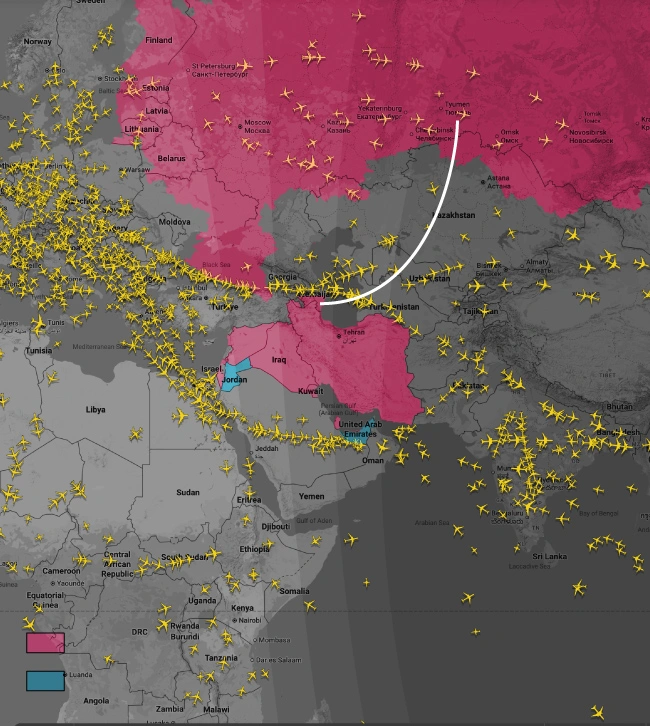











Over the last few weeks, operators flying between Europe and Asia have faced a familiar but increasingly difficult challenge: rapidly changing airspace restrictions across the Persian Gulf region and surrounding FIRs.
In this kind of environment, flight planning stops being a routine background process. It becomes an operational pressure point.
Routes that were valid yesterday may suddenly become inefficient, risky, or unusable. Dispatchers and operations teams have to quickly understand what can still work, what must be avoided, whether additional tech stops are required, and how the new routing affects time, fuel, payload, and overall trip feasibility.
This is exactly where integrated route calculation becomes critical.
Why speed matters during regional disruption
When geopolitical instability affects major air corridors, every delay in decision-making creates operational friction.
Teams may need to answer questions such as:
Can this flight still be operated without crossing sensitive airspace?
What happens to total flight time if several countries or FIRs must be avoided?
Is a technical stop now required?
Does the route remain commercially viable?
Can dispatch evaluate multiple alternatives quickly enough to support clients and crews?
If route intelligence is not embedded directly into the operator’s internal workflow, the process slows down immediately. Teams begin testing scenarios manually, waiting for recalculations, or moving between disconnected systems under time pressure.
That is where mistakes, delays, and poor commercial decisions start to appear.
The role of the Aviapages API
The Aviapages Flight Time & Fuel Calculator API is designed to solve exactly this problem.
When integrated inside an operator’s internal system, dispatch platform, broker workflow, or operational software, it allows teams to generate updated route calculations in seconds.
That includes scenarios with:
avoided countries
avoided FIRs
restricted or sensitive regions
revised routing options
updated flight time logic
operationally usable alternatives for planning and client communication
This means dispatchers and operations teams are not forced to rebuild assumptions manually each time the operating environment changes.
Instead, the system responds immediately.
Real examples from recent operator requests
Below are several recent examples of routes recalculated for operators during the current disruption affecting the Persian Gulf region.
These examples illustrate how quickly route structures can change once airspace avoidance becomes necessary.
Example 1: Munich to Bangkok
A long-range business aviation route that required reassessment due to airspace sensitivity across the Gulf region and surrounding areas.
The recalculated scenario allowed the operator to immediately compare the direct routing logic with an alternative path designed around the relevant restrictions.
Insert screenshot: Munich → Bangkok
This kind of comparison is especially important when operations teams need to decide whether the trip remains efficient enough as planned or whether a different operating concept is required.
Example 2: Paris to Shanghai
A Europe-to-China cargo scenario where the route had to be rebuilt under avoidance constraints, creating a significantly different path than the original great-circle option.
Insert screenshot: Paris → Shanghai
For cargo operators, changes like this can have a direct commercial impact. A longer route may affect fuel burn, block time, crew considerations, and delivery economics. During volatile periods, these decisions need to be made quickly and based on live operational logic.
Example 3: Multi-leg route rebuild under restricted-area pressure
In some cases, a simple reroute is not enough. The operational answer requires a completely different multi-leg structure with alternative stop planning.
Insert screenshot: multi-leg route example
This is where calculation speed matters even more. When several route options need to be tested in a short time, integrated API access allows operators to move from uncertainty to a workable decision almost immediately.
Example 4: Warsaw to Tokyo
Long-range routes between Europe and Northeast Asia can also become materially different when sensitive countries or FIRs must be avoided.
Insert screenshot: Warsaw → Tokyo
Even when a route remains technically possible, the operator still needs to understand whether the new routing is commercially and operationally acceptable.
Example 5: Nice to Malé
A business aviation route to the Indian Ocean region that demonstrates how airspace avoidance can reshape southbound operations as well.
Insert screenshot: Nice → Malé
This is particularly relevant for private aviation, where schedule flexibility, passenger expectations, and aircraft performance all need to be balanced in real time.
From “calculation” to operational resilience
In calm conditions, a routing API saves time.
In unstable conditions, it does something more important: it increases operational resilience.
That is the real difference.
When route intelligence is built directly into internal systems, operators can:
test alternatives immediately
reduce manual dispatch workload
react faster to airspace changes
make better fuel and stop-planning decisions
support clients with realistic options, not estimates delayed by manual work
During fast-moving regional disruption, this becomes a competitive advantage.
Not because the system looks impressive, but because it helps teams act while others are still trying to understand what changed.
Why this matters for operators and aviation platforms
Airspace disruption is no longer a rare exception. Operators, brokers, cargo teams, and aviation software providers all need tools that are built for a world where route assumptions can change overnight.
That means route calculation should not sit outside the workflow.
It should be inside the workflow.
If a team has to leave its system, request a manual check, and wait for someone to come back with options, the technology stack is already too slow for the reality of current operations.
Final thought
When the operating environment becomes unstable, the value of infrastructure becomes very obvious.
The question is no longer whether route disruption will happen.
The question is whether your system can respond fast enough when it does.
That is exactly the problem the Aviapages API is built to solve.