










A single charter quote may take only a few minutes. But multiply those minutes by 50, 100 or 300 requests, and the impact on a sales or dispatch team quickly becomes significant.
For charter brokers and operators, quoting is not simply a matter of entering two airports and multiplying flight time by an hourly rate. Aircraft performance, routing, fuel requirements and operating costs can all influence the final estimate.
That raises a simple question:
How much time does your team actually spend preparing 300 charter quotes? And, more importantly, how much of that work could be automated?
Where the Time Goes in Charter Quoting
A charter request typically starts with a few basic inputs:
• departure airport;
- • destination airport;
- • aircraft type;
- • travel date;
- • passenger requirements.
But turning those details into a useful estimate often requires several additional calculations.
The team may need to determine:
Flight time.
Different aircraft can produce different flight times on exactly the same route because of cruise speed, performance, routing and other operational factors.
Fuel burn.
Fuel consumption depends heavily on the selected aircraft and flight profile.
Estimated operating cost.
A realistic quote needs more than a generic distance-based estimate.
Aircraft comparison.
The fastest aircraft is not necessarily the cheapest, and the aircraft with the lowest hourly rate may not always produce the lowest total flight cost.
When these calculations are performed manually — or across several different tools — even a small amount of additional work per quote can become a major workflow problem at scale.
Five Minutes Becomes 25 Hours
Consider a simple example.
If manual calculations and data entry add only five minutes to each quote:
300 quotes × 5 minutes = 1,500 minutes
That is 25 hours of work.
And five minutes is not necessarily the full quotation process. It may simply represent the time spent switching between tools, checking aircraft data and calculating the initial flight estimate.
This is why the most useful question is not:
“How fast can we calculate one quote?”
It is:
“What happens when we repeat this workflow hundreds or thousands of times?”
Aircraft-Specific Calculations Matter
Distance alone does not tell the full story.
Imagine two aircraft flying the same route.
They may have different:
- • cruise speeds;
- • fuel consumption;
- • range limitations;
- • operating costs;
- • flight times.
As a result, an aircraft that appears more expensive based on its hourly rate could sometimes produce a competitive — or even lower — total trip estimate because it completes the flight faster.
For brokers, this can help when comparing aircraft for a customer.
For operators, accurate aircraft-specific calculations can make the quoting process more consistent across the sales team.
Instead of relying on generic averages, the calculation starts with the performance characteristics of the selected aircraft.
A Simple 300-Quote Test
One practical way to evaluate a quoting tool is to test it in a real workflow. Take your next 300 charter requests and compare the process with your existing method.
Measure:
1. Time per quote
How long does it take your team to calculate flight time, fuel burn and an initial flight cost estimate?
2. Number of manual steps
How many tools, spreadsheets or browser tabs are involved?
3. Repeated data entry
How often does the same airport, aircraft or route information need to be entered more than once?
4. Aircraft comparison time
How quickly can the sales team compare multiple aircraft for the same trip?
5. Total time saved
Even a saving of two or three minutes per request becomes significant across hundreds of quotes.
This turns “faster quoting” from a marketing claim into something your team can actually measure.
Calculating a Quote with Aviapages
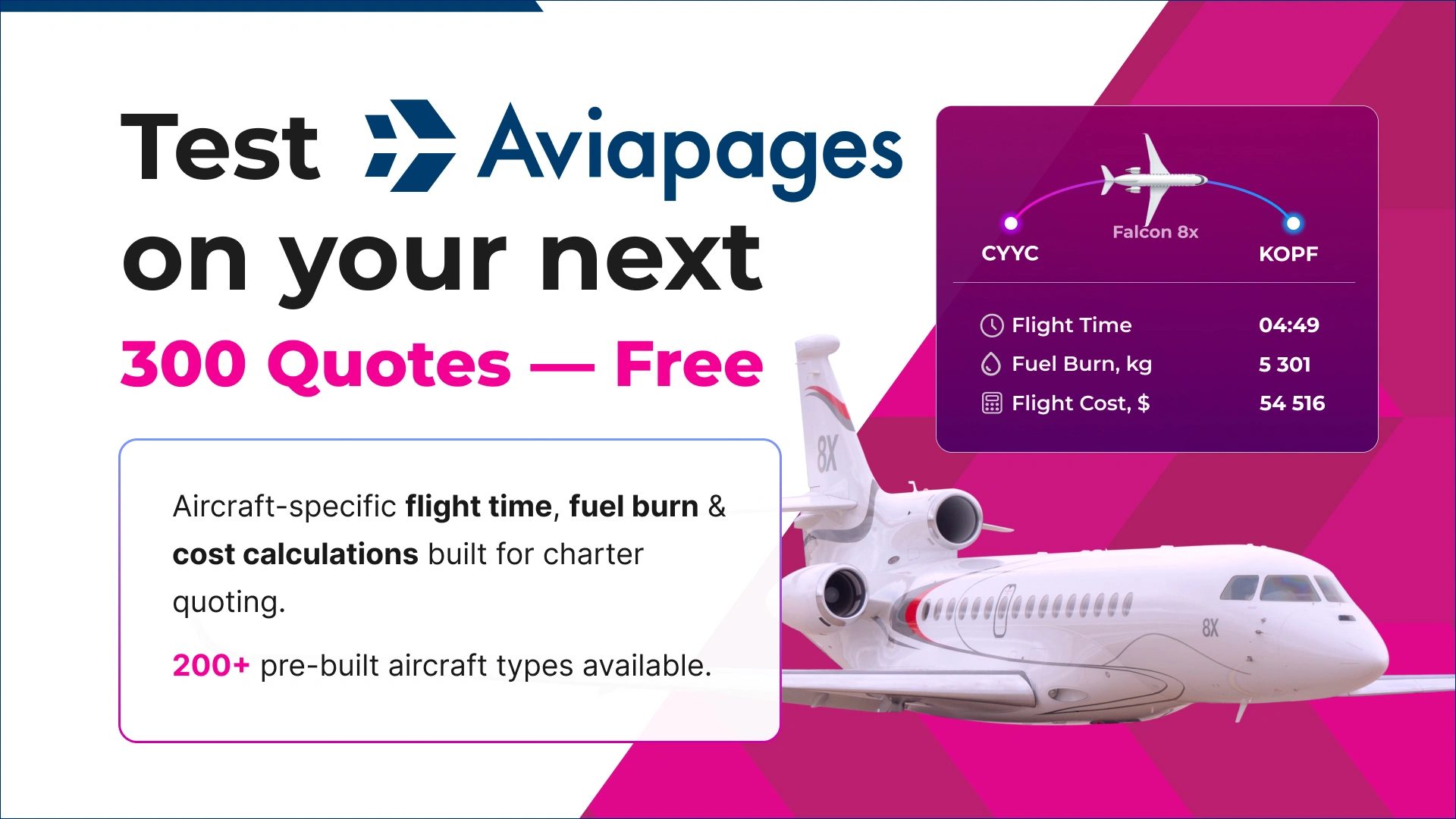
The Aviapages Flight Time and Charter Cost Calculator is designed for business aviation workflows.
It provides aircraft-specific calculations including:
- • flight time;
- • fuel burn;
- • estimated flight cost.
More than 200 pre-built aircraft types are available, allowing users to calculate and compare different aircraft without creating performance models from scratch.
For an individual broker or sales manager, this can reduce the number of manual calculations required to prepare an initial estimate. But for companies processing larger volumes of requests, the bigger opportunity is automation.
From Calculator to API
When charter quoting happens occasionally, using a calculator directly can be enough. When it happens hundreds or thousands of times, an API can become more valuable.
The Aviapages API allows companies to integrate aviation calculations into their own:
- • quoting platforms;
- • CRM systems;
- • charter marketplaces;
- • operator software;
- • internal quoting tools.
The Aviapages Flight Time API can return estimated flight time, wind impact, fuel consumption and airways routing, while the Price Calculator API can calculate charter cost estimates using aircraft-specific pricing profiles, route parameters, airport fees, overflight charges, taxes and other pricing inputs.
For example:
Customer request → Aircraft selection → Flight calculation → Cost estimate → Quote
The calculation becomes part of the existing workflow rather than a separate task. That is particularly relevant for charter companies trying to shorten the time between receiving an inquiry and sending the first estimate to the customer.
Faster Does Not Mean Less Accurate
Automation is most useful when it removes repetitive work without removing professional judgment. A calculator or API does not replace the broker, dispatcher or operator.
Teams still need to consider factors such as:
- • aircraft availability;
- • airport restrictions;
- • slots and PPR;
- • positioning;
- • handling;
- • crew requirements;
- • weather;
- • commercial margins;
- • customer preferences.
Instead, automated flight calculations can remove some of the repetitive mathematical work that happens before these decisions are made. The result is not necessarily fewer people involved in quoting. It is more time available for the parts of the quote where human expertise matters.
Test Aviapages on Your Next 300 Quotes
If your team processes a significant number of charter inquiries, try measuring the workflow rather than guessing. Use Aviapages for your next 300 charter quotes — free.
Then compare:
How many minutes did you save per quote?
How many hours did your sales and dispatch teams save in total?
Even a small improvement per request can become meaningful at scale.
Try Aviapages
Calculate aircraft-specific flight time, fuel burn and estimated flight cost using the Aviapages Calculator. For companies building automated quoting workflows, explore the Aviapages API.