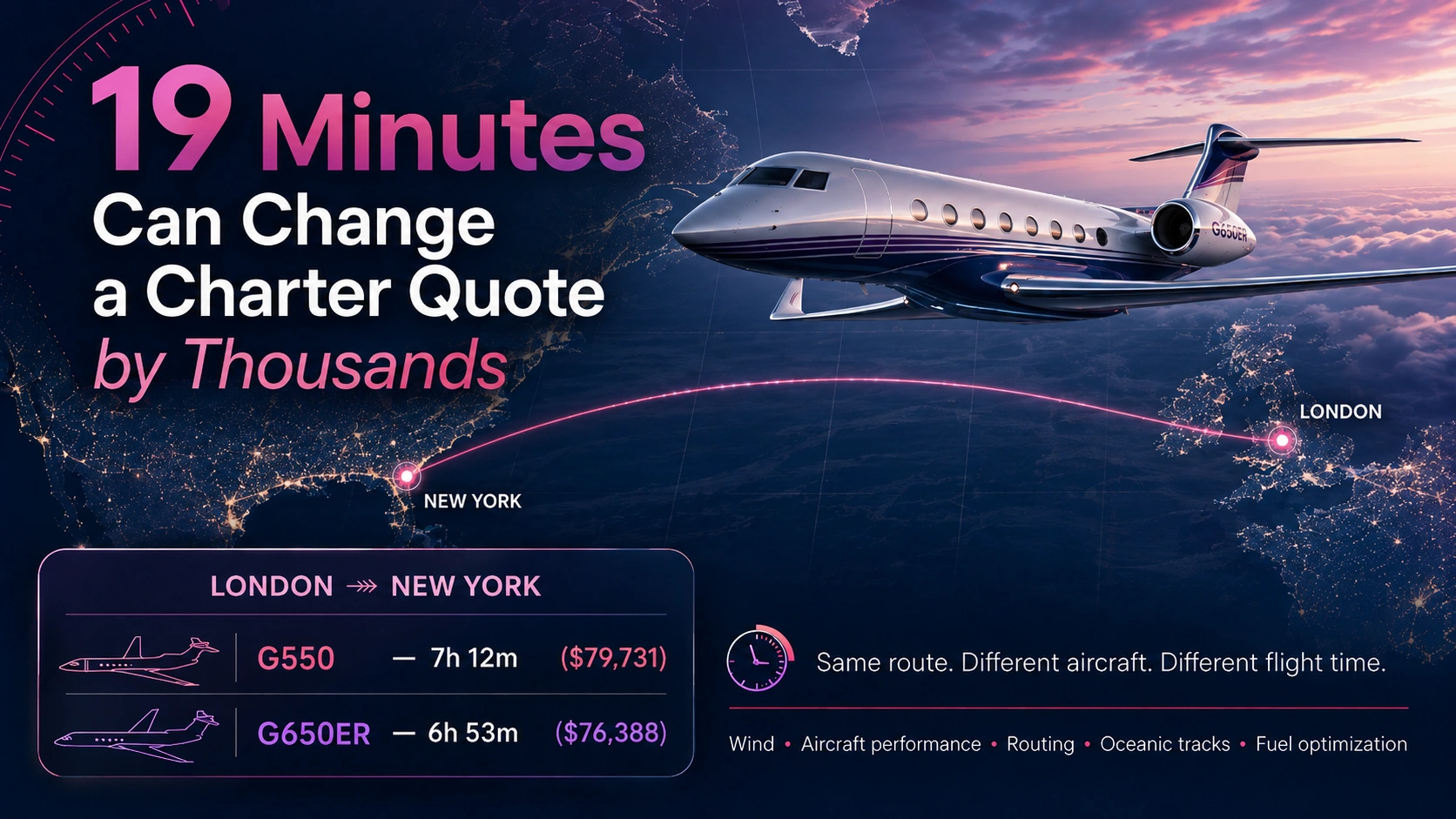











When preparing a private jet charter quote, 19 minutes may not sound significant. But on a long-haul business aviation flight, differences in aircraft performance, routing, winds and operating economics can turn a relatively small flight-time difference into thousands of dollars.
Consider a London–New York charter flight.
Using the same route and comparable trip parameters, two long-range Gulfstream aircraft can produce noticeably different estimates:
London → New York
Gulfstream G550
Estimated flight time: 7h 12m
Estimated charter cost: $79,731
Gulfstream G650ER
Estimated flight time: 6h 53m
Estimated charter cost: $76,388
That is only 19 minutes of flight-time difference, but the estimated charter prices differ by $3,343. The important point is not that those 19 minutes alone create a $3,343 difference. Charter pricing depends on the aircraft and its operating economics as well.
The lesson for charter brokers and operators is more useful:
The same city pair does not automatically mean the same flight time — and flight time should not be estimated from distance alone.
Why Can Flight Time Differ on the Same Route?
A straight line between London and New York looks identical regardless of which business jet is selected. The actual flight calculation is not.
Several variables can change the result.
1. Aircraft Performance
Different aircraft have different cruise speeds, climb profiles, operating altitudes, fuel consumption and performance characteristics. The G550 and G650ER are both long-range Gulfstream business jets, but they do not fly an identical performance profile.
This means that simply knowing the distance between two airports is not enough to produce an accurate private jet flight time estimate. For charter brokers comparing aircraft options, aircraft-specific performance matters.
2. Winds
Wind can have a major impact on long-haul flight time. A strong headwind can increase the time required to complete a route, while favorable winds can reduce it.
This becomes particularly important on transatlantic flights such as London to New York, where wind conditions can materially change the expected flight duration. A quote based only on still-air distance can therefore differ from a calculation that incorporates actual or forecast wind conditions.
3. Actual Routing
Aircraft rarely fly the exact straight-line distance shown between two airports on a map. Airways, ATC requirements, restricted airspace, departure and arrival procedures, country avoidance and other operational considerations can increase the distance actually flown.
Two calculations for the same London–New York city pair may therefore produce different flight times depending on the routing assumptions being used.
For a charter quote, the relevant question is not simply:
How far apart are the airports?
It is:
How is this aircraft likely to fly between them?
4. North Atlantic Routing
Transatlantic operations add another variable. North Atlantic tracks can change according to traffic flows, weather and winds. The optimal path on one day may not be the optimal path on another.
For brokers and operators quoting long-range private jet flights, this is one reason why a static distance-based estimate can be misleading. The route needs to be considered together with the aircraft and current operating conditions.
5. Fuel Strategy and Flight Profile
The fastest possible flight profile is not necessarily the most economical one. Higher cruise speeds can affect fuel burn, while aircraft weight, altitude and operating strategy can influence both flight time and cost.
That creates an important trade-off when preparing a preliminary charter estimate:
speed, fuel consumption and operating cost are interconnected.
Why 19 Minutes Matter When Quoting a Charter Flight
On a short commercial trip, 19 minutes may appear insignificant. In business aviation, every additional portion of flight time can affect operating costs.
Depending on the aircraft and pricing model, a charter estimate may include factors such as:
- ▪ aircraft hourly cost;
- ▪ fuel consumption;
- ▪ crew costs;
- ▪ airport and handling charges;
- ▪ positioning;
- ▪ minimum daily charges;
- ▪ overnight costs;
- ▪ operator margin;
- ▪ taxes and regional fees.
That is why small differences in the flight calculation can become commercially meaningful. In our London–New York example, the G550 estimate is 7h 12m and $79,731, while the G650ER estimate is 6h 53m and $76,388.
The faster aircraft is also approximately $3,343 cheaper in this particular calculation. That does not mean a G650ER will always be cheaper than a G550. Aircraft availability, positioning, operator pricing, airport charges and many other variables can completely change the final charter offer.
It demonstrates something more important:
Aircraft selection can change both the operational calculation and the economics of the quote.
The Problem With Distance-Based Charter Estimates
A rough calculation such as:
distance ÷ average cruise speed = flight time
can be useful for a very quick approximation.
But it misses much of what matters in real-world business aviation.
For a broker responding to a customer, even a preliminary estimate becomes more useful when it reflects the selected aircraft rather than a generic aircraft category or straight-line distance.
A better charter flight calculation should consider the route together with:
Aircraft → Performance → Winds → Routing → Fuel → Cost
This gives sales teams a more realistic starting point before the operator prepares the final operational flight plan and confirms the charter offer.
Calculate Before You Quote
Speed is important in charter sales. A customer requesting a private jet often expects a response quickly, and brokers cannot always wait for a detailed manual calculation before providing an initial estimate. Brokers can also request and compare private jet charter quotes from multiple operators when sourcing an aircraft for a trip.
But faster quoting should not mean guessing. The Aviapages Flight Time & Cost Calculator allows brokers and operators to compare aircraft-specific flight time, route, fuel consumption and estimated charter cost across more than 500 aircraft types. For companies handling a high volume of charter requests, the same flight time and pricing technology can also be integrated directly into an existing quoting workflow through the Aviapages Flight API.
For a route such as London–New York, changing the aircraft can immediately show how the estimated flight time and charter cost change with it.
That makes aircraft comparison useful not only for flight planning, but also for commercial decision-making.
Before quoting the next charter request, do not assume that the same route means the same flight time. Calculate the aircraft. Calculate the route. Calculate the flight.
Try the Aviapages Flight Time & Cost Calculator.
The flight times and charter costs shown above are estimates generated for a sample calculation. Actual flight time, routing and charter pricing may vary depending on weather, aircraft configuration, payload, operator pricing, aircraft positioning, airport conditions and other operational factors.