










Why detecting intoxication isn't the same as managing fitness for duty
What is confirmed, and what is not
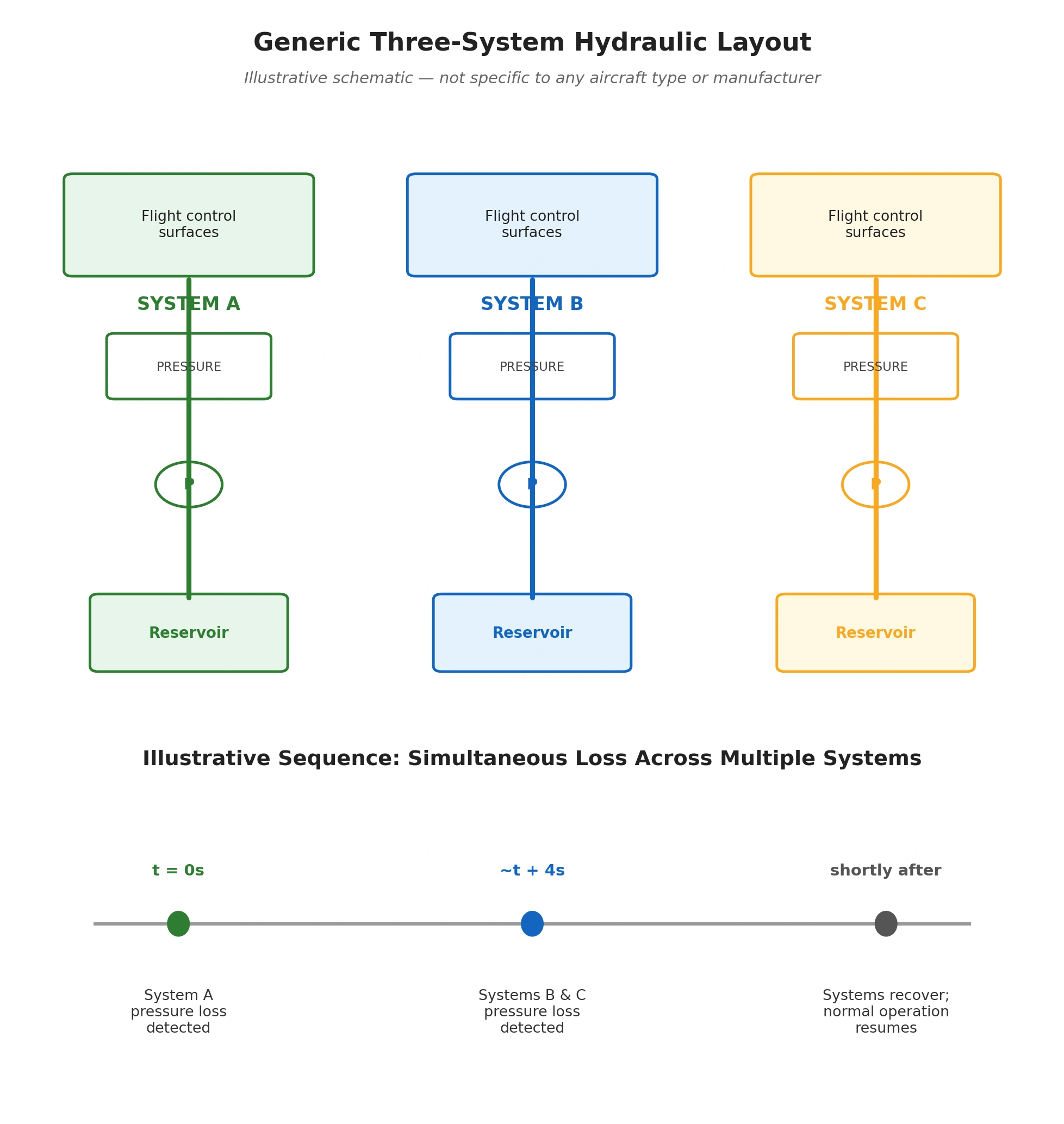
On 4 August 2026, Air India flight AI2379, an A320neo carrying 137 passengers, two pilots, and six cabin crew from Phuket to Delhi, encountered what the AAIB's preliminary report, published 4 September 2026, terms an altitude upset while cruising at flight level 360: the aircraft detected a loss of pressure in its green hydraulic system, followed roughly four seconds later by losses in the blue and yellow systems, triggering autopilot disconnection and a two-second stall warning. The aircraft initially climbed 372 feet before descending 292 feet below its assigned level, following the detected loss of all three hydraulic systems; its hydraulic systems and flight-control surfaces then recovered, allowing normal operation to resume. Twenty-four passengers and crew were injured. The co-pilot, who was the Pilot Flying, responded first and worked to control the aircraft, after which the pilot-in-command took over the controls; the crew continued to Delhi and landed safely, requesting medical priority on arrival.
The preliminary report states that the technical cause of the hydraulic-pressure losses has not yet been established, and investigators have removed hydraulic components and fluid samples, along with flight-data and cockpit-voice recorder data, for further analysis.
Separately, the same preliminary report states that the pilot-in-command tested non-negative for a psychoactive substance in a confirmatory test, while the co-pilot tested negative on both the initial and confirmatory tests. The AAIB described the captain's result as a serious concern and recommended that the DGCA take appropriate action. The report does not establish a causal link between the psychoactive-substance finding and the hydraulic-system losses, the brief control interruption, or the altitude upset, and the investigation into the technical cause, crew actions, and other aspects of the flight remains ongoing. The pilot has reportedly told investigators he had been experiencing sleep difficulty and was taking a doctor-prescribed medication before the flight. As things stand, the technical sequence, the toxicology finding, and the sleep-related self-report are three separate threads under a single ongoing AAIB inquiry — not an established chain of causation. This article treats the incident as an illustration of a structural question in aviation safety oversight, not as a conclusion about what caused the upset.
What is not in dispute is the industry's response. Within days, Air India moved beyond routine random testing to a one-time mandatory psychoactive-substance screen of its entire pilot workforce — a step that goes beyond what India's Directorate General of Civil Aviation (DGCA) currently mandates under Civil Aviation Requirement (CAR) Section 5, Series F, which sets a random annual testing rate rather than a full-workforce screen. That operational decision, independent of what the AAIB ultimately finds, is worth examining on its own terms.
What testing is built to catch — and what it structurally cannot
Substance-testing regimes worldwide — DGCA's breath-analyzer and psychoactive-substance CARs, the FAA's drug and alcohol testing program under 14 CFR Part 120 and 49 CFR Part 40, and the ICAO framework set out in Doc 9654, the Manual on Prevention of Problematic Use of Substances in the Aviation Workplace — share a common design logic: detect a prohibited substance in a person's system at a specific, testable moment. Under DGCA's framework, operators must test a defined minimum share of flight crew and air traffic controllers annually, with additional pre-employment, post-accident, and follow-up testing for confirmed cases. The FAA's program similarly specifies pre-employment, random, reasonable-cause, post-accident, return-to-duty, and follow-up testing categories.
These are well-established, legally grounded controls, and none of what follows argues for weakening them. But by design, they answer a narrow question — was a prohibited substance present — rather than the broader operational question of whether a pilot's overall state, on a given day, elevates risk. One specific, published limitation is worth flagging carefully: toxicology literature indicates THC metabolites can remain detectable in urine well after any impairing effect has ended, meaning a positive result can reflect recent use rather than same-day impairment — a distinction regulators and researchers have both flagged as an unresolved measurement problem. A second limitation is panel scope: standard testing panels are built around defined categories of controlled substances and are not designed to screen for the broader set of legally prescribed medications that can also impair cognition or reaction time.
Fatigue risk management already exists — the gap is integration, not coverage
Aviation already has a formal, ICAO-defined mechanism for fatigue: the Fatigue Risk Management System (FRMS), codified in Annex 6, Part I, Appendix 8, and detailed in ICAO Doc 9966. ICAO defines an FRMS as a data-driven means of continuously monitoring and managing fatigue-related safety risks, based on scientific principles and operational experience, and its scope is broader than duty-time scheduling alone: a properly implemented FRMS can incorporate bio-mathematical fatigue modelling and self-reported data covering sleep quality and other personal factors, not just roster design. FRMS is a real, functioning regulatory tool, and any broader fitness framework has to be built as a complement to it, not a reinvention of it.
The gap this article is concerned with is narrower than 'FRMS doesn't cover personal fatigue.' It is that FRMS, substance testing, medication disclosure, and voluntary wellness reporting currently operate as separate systems, each producing its own data, with no standardized mechanism to combine their outputs into a single before-flight fitness picture. A proposed Pilot Fitness Risk Management System (PFRMS) — the term used here for clarity, and offered as a discussion framework rather than an established or validated system — would sit above existing testing and FRMS programs, integrating their outputs rather than replacing either.
What a broader fitness framework would need to get right
Any system that aggregates fatigue, medication, and wellness signals into a single risk picture raises real privacy, regulatory, and practical questions that have to be designed for up front, not addressed after deployment.
On privacy: continuous or wearable-derived data collection touches sensitive personal health information. Any such program would need to be opt-in, governed by clear data-minimisation and retention limits, and firewalled from human-resources or disciplinary use. On outcome evidence: the FAA's long-running Human Intervention Motivation Study (HIMS) — a peer-support, return-to-duty pathway for pilots with substance-use or mental-health issues, administered in partnership with the Air Line Pilots Association — is the industry's most established non-punitive model and is credited by supporters with helping many pilots return to flying. However, a 2023 congressionally mandated National Academies of Sciences, Engineering, and Medicine review — the first independent evaluation in the program's history — found that HIMS's outcome data did not allow its claimed effectiveness to be independently substantiated. That finding is a reason to study HIMS's structure carefully rather than treat it as settled proof that any particular monitoring approach works.
On regulatory fit: a PFRMS-style layer would need to operate within, not around, existing DGCA, FAA, and ICAO frameworks — as an operator-level safety management system addition subject to regulator review, not a parallel compliance regime. On practicality: any aggregated score would need to remain explainable to the human reviewer using it, subject to independent audit, and paired with a fast appeals process, since an opaque or high-false-positive system would likely be circumvented by the same workforce whose honest engagement it depends on.
Where the three frameworks already stand
DGCA, ICAO, and the FAA converge on a strict, near-zero standard for alcohol. They diverge more in how far fatigue and mental-health disclosure extend beyond duty-time regulation, and in how testing detection windows are handled for non-alcohol substances. This review did not identify a standardized DGCA, FAA, or ICAO framework that combines substance-testing results, FRMS fatigue data, and voluntary wellness or medication disclosure into a single integrated fitness assessment; each currently operates as a separate regulatory track. That structural separation — not any single regulator's shortcoming — is the specific gap this discussion is aimed at.
The open question
Whatever the AAIB ultimately finds about AI2379, the case has already surfaced a structural question that doesn't depend on its findings: existing testing and FRMS regimes are each well-designed for what they individually measure, but this review did not identify a framework that combines them into a single before-flight fitness picture. Whether that gap is worth closing — and if so, how to do it without creating new privacy or false-positive problems — is the conversation this article is intended to start, not settle.