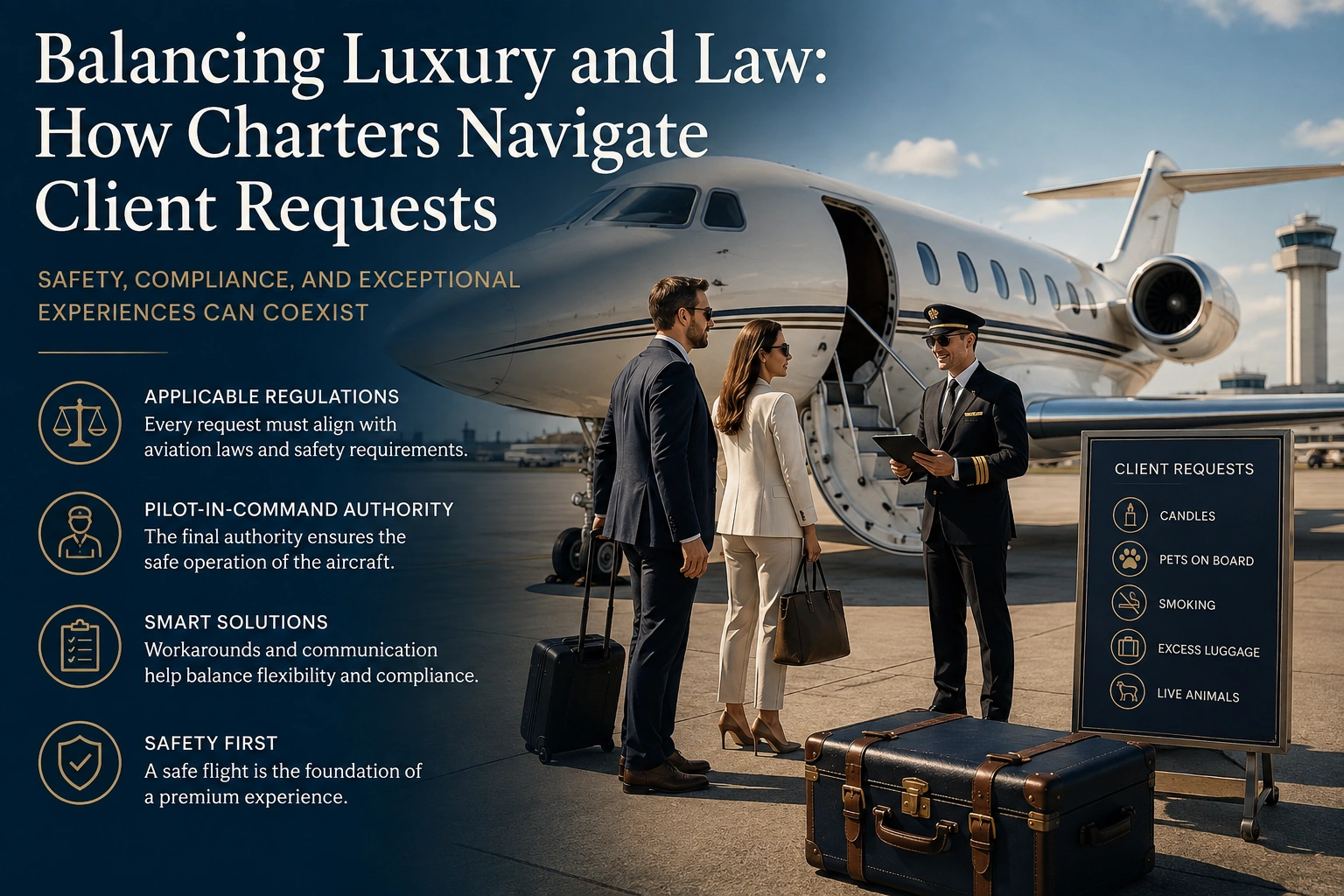











Charter clients often struggle with aviation rules for two reasons. For one, since they often bypass commercial flight checks and restrictions, they are accustomed to flying quite comfortably without having to think about the nitty-gritty stuff, such as how many millilitres of lotion are in their bags. And two, they are used to getting their way regarding what they experience before and during their flights. Thus, they find it hard to gauge just where this flexibility ends, which shows up in how they view rules.
As such, it is not uncommon for them to make requests that directly violate applicable aviation regulations, operator procedures, or safety requirements, thus putting the charter operators in a precarious situation. We look at what these regulations require and how you can toe the line without stepping on your clients' toes.
What Aviation Rules Might Clients Want to Bend or Break?
Client satisfaction is a key consideration in charter flights, and charter operators often go out of their way to ensure that their clients are happy. For example, if they experience an unexpected AOG, they do not let it derail their flight schedules. Instead, they turn to organisations like Magnetic Enginestands (magneticenginestands.co) to provide them with reliable engine stands which they can use to repair, maintain, or overhaul their engines. Having reliable AOG support can help operators resolve technical issues efficiently and keep their focus on delivering a safe and compliant flight experience, even when unexpected problems arise. While some problems are easy to address, others leave charter operators scratching their heads, wondering just how far they should go in pursuit of client satisfaction.
In fact, in the years gone by, charters have encountered all sorts of clients whose demands have exceeded what they can provide. Examples include clients who want to light candles in the cabin, passengers who want their pets to sit loose in the aisles during takeoff, people who want to smoke in the cabin, and people who want to overload the planes with heavy luggage. There have even been incidents of people attempting to board charter flights with live wild animals that lack clearances and approved transport restraints.
In all these cases, the charter operators have found themselves grappling with complex requests that directly contravene applicable aviation regulations, operator procedures, and safety requirements concerning the following:
● The weight, balance, and performance limits of airplanes;
● The cabin safety protocols;
● Flight and duty time limitations for flight crew;
● The transport of dangerous goods;
● The required maintenance procedures between flights.
And most importantly, the pilot-in-command has final authority regarding the safe operation of the aircraft. So, while the rules may say one thing, the clients may want something entirely different, and this can result in friction between the parties.
Is There A Balance?
Charter flights do offer a lot of flexibility regarding what clients can do, including what they can have as luggage. But even so, there are limits.
And when clients attempt to push these limits, here are ways you can handle the situation without alienating them:
● Offer workarounds. If what clients want is against applicable aviation regulations or operator safety procedures, you can look for a way to meet their request without breaking the laws. For example, if a client wants to light candles on their cake, you can offer them LED flame candles or organise a cake-cutting ceremony with real candles before the flight. Or let’s say that a client wants to carry excess cargo; you can suggest that they charter a second aircraft to split the luggage between two flights;
● Blame it on the aviation laws. In cases where workarounds are not possible, you can shift the blame to applicable regulations and safety requirements, thus positioning the aviation authorities as having power over you. Doing so creates a boundary without making the refusal feel personal. For instance, if someone wants to smoke during the flight, you can explain that doing so may conflict with applicable regulations, safety requirements, or the operator’s policies and could put the operation at risk;
● Vet passengers before flights. Clients may conceal their true intentions until it is time for the flight. So, rather than uncover surprises later during the flight, it is advisable to stay on top of things by conducting screening before the flight, such as reviewing special manifests. This way, you can identify and deny illegal and unapproved items at the private terminal rather than in the cabin.
At the end of the day, you still have the power to determine what happens on the flight. And given that these actions could jeopardise your operating license, it is important to seek diplomatic ways to reach a middle ground with your clients. When all else fails, the pilot-in-command can exercise their authority to protect the safe operation of the aircraft, including refusing a request that cannot be safely or legally accommodated or, where operationally necessary, taking appropriate action such as delaying, cancelling, or diverting the flight.